Sunday, July 31, 2016

New Releases from BK Wines in the Adelaide Hills

BK WINES CHARDONNAY

It was nice to be able to drink these new releases from Brendon and Kirstyn Keys of BK Wines. I’m really impressed by them, and they’re gaining quite a reputation in Australia, and lately abroad. Working quite naturally, but with very refined, clean wines.

BK Wines Petillant Naturel Chardonnay 2016 Adelaide Hills, Australia
This Pet Nat is undisgorged, so it’s quite cloudy when you open it. It’s sweet, textural and shows lovely pear and peach fruit with a hint of spiciness. It has quite a smooth texture and is broad, off-dry and delicious. So easy to drink, this is a very successful expression of this style that’s often tricky to do well. 89/100

BK Wines Pinot Grigio 2016 Adelaide Hills, Australia
Fresh with lovely tangerine and grape fruit characters, as well as some subtle herby detail. There’s some substance to this wine. It’s dry, but it has a bit of texture and some complexity, too. 90/100

BK Wines Archer Beau Chardonnay 2015 Adelaide Hills, Australia
Super-complex, linear and taut with lovely mineral notes and well integrated, high-quality oak. Fine matchstick notes add interest with hints of pepper alongside the linear citrus fruit. Bright, precise, lemony and pure, this is superb and should develop very well. 94/100

OLYMPUS DIGITAL CAMERA

BK Wines Rosé 2016 Lenswood, Adelaide Hills, Australia
Fresh, lively and bright with nice sweet cherry, plum and rhubarb notes. Supple and delicious with nice strawberry and cherry fruit, and good texture. 90/100

BK Wines Mazi Whole Bunch Syrah 2014 Adelaide Hills, Australia
Hints of mint here, with nice fresh black fruits and some subtle hints of tar. Very detailed with a savoury edge. There’s such good structure here: a really interesting Syrah with massive potential. 93/100

BK Wines Remy Pinot Noir 2015 Lenswood, Adelaide Hills
Sweetly aromatic cherry fruit nose leads to a beautifully supple palate. It’s juicy and fresh with fine herbiness and some citrus fruit. Elegant and textural with hints of pepper and a fine green note adding definition. 94/100

Find these wines with wine-searcher.com


from jamie goode’s wine blog http://www.wineanorak.com:/wineblog/australia/new-releases-from-bk-wines-in-the-adelaide-hills

For Fine Wine Investment opportunities check out Twelve by Seventy Five: http://www.twelve-by-seventy-five.com/

from
http://twelvebyseventyfive.tumblr.com/post/148240613112

Saturday, July 30, 2016

The social licence of wine

I’ve been at the excellent Australian Wine Industry Technical Conference this week, where I presented on two topics. The first was on whether or not we make too much of terroir, and the second was on the social licence of wine. Here’s a written version of some of the ideas that I discussed in the second of these talks, which covered some tricky territory.

Wine’s privileged place
In the wine trade we are guilty of taking wine’s place in society for granted. For thousands of years wine has played an important part in many cultures. This has largely been in countries of wine production, but other nations have also had a thirst for wine: for example, the UK has been important in the development of the wine industries of Bordeaux, Jerez and Porto. Emigrants from wine cultures have taken their wine culture with them: for example, the Dalmatians at the heart of the NZ wine industry and the Silesians of the Barossa Valley.

In western societies, wine currently enjoys a privileged place compared with other alcoholic beverages. This seems entirely normal to us, now, but if we take a step outside the wine trade bubble and look inwards, then it is an unusual situation. It is in some ways a historical artefact, but it is one that we should work hard to preserve.

Wine has a privileged place on the table. In restaurants worldwide, wine and food have been linked to the point that when diners are seated they are offered a wine list. This will include other drinks, but it is wine that enjoys primacy. Food and wine matching is seen as an intrinsic part of fine dining. This is something the wine trade should celebrate, but something we shouldn’t assume will continue for ever.

At a more basic level, in most western countries people are free to buy and consume booze, with little regulation other than licensing of shops and venues, and some extra taxation. We’re able to operate.

In this article, I will be looking at some of the broader ideas surrounding the social licence of wine. This is an important discussion for the wine industry, but it’s also a complex one.

Alcohol and health
As I write I’m on a plane on the way to Australia. I remember the first time I flew to Australia, back in March 1996. Trying to find the cheapest flight, I opted for Olympic Airlines, Greece’s National carrier. It seems strange to think about it, but back in those days (20 years ago, now, but it seems quite recent) people used to smoke on planes. As we checked in, with our paper tickets, we were assigned seats in the smoking section. Our protests fell on deaf ears, and we had to fly at the back of the plane, where the 80% of the flight (mostly Greeks, practically all of whom smoke) congregated to puff away. It was pretty grim. Now of course, no one smokes on planes. It just seems a stupid idea. No one smokes in bars. No one smokes in the office. Advertising of smoking is severely restricted in many countries, and the display of cigarettes at point-of-sale is also commonly banned. This is a massive societal change, and from the perspective of me, as a non-smoker, it’s brilliant. Society has quite rightly become very anti-smoking.

Worryingly, though, society has also become somewhat anti-drinking, too. This change is not as dramatic, but for those of us in the wine trade, it’s certainly something we should be concerned about. The argument in favour of drinking is that there is a safe level of consumption, whereas any level of smoking is hazardous. This distinction is one that is now being disregarded in the UK by public health authorities, with the message being one that any level of drinking carries with it risk. Many in the public health sector would like to do to alcohol what they have done to tobacco.

The evidence against alcohol is mounting. The abuse of alcohol is widespread, and attempts have been made to quantify it. These reports make for sobering reading (apologies…). Of course, there’s no way of knowing how real the figures quoted are (and, just as with many grant proposals which begin with an assessment of the cost of the problem that the research is intended to solve, the numbers seem awfully big), these sorts of figures are likely to influence policy decisions.

The Institute of Alcohol Studies published a report in 2015 titled Alcohol’s Harm to Others. This is a quote from it:

In the UK, the cost of alcohol’s harm to others was estimated in 2004 at up to £15.4 billion including £1.4-1.7 billion to the health service, up to £7.3 billion in crime and public disorder costs and up to £6.4 billion in workplace related costs. Further, there are costs to family and social networks that cannot be quantified using available data, for example the cost to children affected by parental alcohol problems. More recent figures calculated for the European Union place the societal costs of alcohol consumption in 2010 at € 155.8 billion (£115.4 billion). In Australia, the tangible costs per year resulting from other’s alcohol consumption are estimated at AUS $14.2 billion (£7.2 billion) and the intangible costs at AUS $6.4 billion (£3.3 billion). Given limited government resources, this alcohol-related spending reflects a large opportunity cost in terms of other areas of healthcare or government spending sacrificed.

To governments in western nations, figures like this mean that the appeal of restricting alcohol availability through higher taxation, or limiting retailing or advertising, is irresistible.

Binge drinking among teenagers and younger adults is a huge problem in the UK. Chaotic drinking patterns are resulting serious liver damage – a hepatic surgeon I spoke to said that he’s regularly seeing patients with end-stage liver failure in their late 20s. And city centres on Friday and Saturday nights are turning into dangerous places. There is a strong motivation for public health bodies to do something.

Against this backdrop, the UK Chief Medical Officer, Dame Sally Davies, has recently initiated a consultation looking to revise safe drinking guidelines. A consultation began in January 2016 on recommended safe drinking levels, and the new recommendations were proposed as 14 units per man/woman per week, and along with this came the announcement that there is no safe drinking level. The 14 units level was derived from setting a relative risk of death as 1%. This means that if you drink 14 units a week you increase your risk of dying by 1%, which is apparently the same level of increased risk as watching on hour of TV a week or eating two bacon sandwiches per week.

Davies did a series of media interviews, including one on Radio 4’s Today programme in which she said this: ‘There’s an old wives’ tale that we were all brought up on – that a glass of red wine protected the heart.’ This is quite an extreme statement, because it flies in the face of the consistent, reliable finding of the J-shaped mortality curve. If you plot risk of death against alcohol consumption, the curve goes down so that for a certain level of drinking you are less likely to die. This is because of the cardioprotective effects of drinking alcohol. But alcohol also increases the risk of cancers and accidents, and at higher levels of stroke and cardiomyopathy, among other conditions. But there remains this sweetspot where moderate drinkers benefit more than they lose in terms of risk of death. This is an important message: there is a safe level of drinking, if you define safety as living longer, on average, than non-drinkers. Anti-alcohol public health people want to remove this message: they want people to think of alcohol as they do with tobacco.

So we have a problem. At the moment we in the wine trade have been granted licence to operate by society, but there are moves to impose further limits on us, and even to revoke this licence. Acceptance by drinks industry of these sorts of extremely conservative recommendations cements them into societal narrative on alcohol: if drinks companies print them on back labels, as they do with current recommendations, it validates them and turns them into a ‘truth’. This could severely affect the way normal people view alcohol, and wine, and in time reduce consumption. People currently drinking a healthy level of wine, for example a couple sharing a bottle over dinner, will be scared off this pleasure. It will be spoiled for them

While the motivation behind recommendations is a good one (there is no disputing that excessive alcohol consumption is a social ill that must be addressed), they are not a fair reflection of the research. The wine industry must be seen to self-regulate and behave responsibly, but must contest misleading presentation of science. This is a difficult balance to get right.

In discussions on taxation, the wine trade needs to act not only in its own interest. In Australia there is a discussion about moving towards a volumetric rather than value-based tax. This would seem to make sense: it’s a tax on alcohol, and it would make cheap products more expensive but would make more premium wines more affordable. The UK has a volumetric system and it works well. There was a recent proposal to move to minimum unit pricing (MUP) for alcohol, and this would have had a very beneficial public health effect. Basically, as you increase the price of booze, you reduce societal harm. The drinks industry opposed this, which I think is short sighted. It would have got rid of a lot of very cynical products that have high alcoholic strength and yet are cheap.

There is also the issue of viticulture and food security. By 2050 the global population is projected to be 9.1 billion (a rise of 34%), and 70% of people will be urban (now 49%). According to a report from the Food and Agriculture Organization, food production will have to increase by 70% to keep everyone fed. There will be a lot of pressure on land and water resources, and viticulture in good farming areas will be under threat as wine is regarded as a luxury not a staple.

If we are to maintain wine’s place in society, then we need to act now and seize the narrative agenda. People don’t listen to facts. Facts don’t change minds – stories and emotions do.

We should tell the story of wine. We should tell people about what we are doing, and explain why we think wine is different. This involves emphasizing its cultural richness, and creating positive associations with wine: gastronomy and beautiful places, for example. We also need to make the link between wine and place explicit, and this is why terroir is so important. We need to show people that wine is a heritage product. It is not just another alcoholic drink.

At the moment the wine trade isn’t having these discussions, and we are leaving the issue of the social licence of wine in the hands of public health officials, many of whom have an anti-alcohol agenda. We can’t sit back and allow alcohol to be turned into the next tobacco, because this would take down wine with it. It’s time for us to initiate these conversations, difficult though they may be.


from jamie goode’s wine blog http://www.wineanorak.com:/wineblog/longer-articles/the-social-licence-of-wine

For Fine Wine Investment opportunities check out Twelve by Seventy Five: http://www.twelve-by-seventy-five.com/

from
http://twelvebyseventyfive.tumblr.com/post/148220072732

Friday, July 29, 2016

An evening in Adelaide: Mothervine, Osteria Oggi and The Exeter

IMG_0973

Had a lovely evening in Adelaide on Wednesday. We began at Mothervine, which is a really good wine bar. There’s just such a good list here, which spans Australian and European, with a nice mix of conventional and more natural. First up, a lovely 2014 Kabinett from Prum, which was so taut and fine, and beautifully balanced. Then it was time for some Gamay: the Farr 2015 was lovely, with a really distinctive personality. There was some green stemminess, but it fitted nicely into the context of sweet pure fruit. Then a real surprise: a gorgeous blend of Tempranillo and Touriga Nacional from SC Pannell in the McLaren Vale.

OLYMPUS DIGITAL CAMERA

By this stage we were getting hungry, so we headed over to Osteria Oggi. This is a brilliant restaurant. Really brilliant.  We ate so well and drank Chianti and Barbera. The food here is perfectly executed and utterly delicious: the mushroom risotto with its generous truffling was quite beautiful. Crab tagliatelle was also fab.

IMG_0968

IMG_0967

IMG_0966

IMG_0964

Finally, time for a good old Aussie pub. The Exeter. We met up with others and got involved in a game of darts. And drank beer. But I clearly hadn’t drunk enough – just a few more beers and my aim would have been truer and my release smoother. It was a lovely evening.


from jamie goode’s wine blog http://www.wineanorak.com:/wineblog/australia/an-evening-in-adelaide-mothervine-osteria-oggi-and-the-exeter

For Fine Wine Investment opportunities check out Twelve by Seventy Five: http://www.twelve-by-seventy-five.com/

from
http://twelvebyseventyfive.tumblr.com/post/148171232452

Thursday, July 28, 2016

10, 20 and 40 year old Tawnies from Fonseca

fonseca tawny

Had a chance to run through these aged tawnies from Fonseca. The 10 year old is pretty good, but the 20 and 40 year olds are remarkable wines, showing lovely elegance and purity, and some red fruit character still. When Tawny is good, it’s pretty irresistible.

Fonseca 10 Year Old Tawny
Warm and spicy with lovely depth. Sweet with some raisiny notes here, with richness and intensity. Bold but quite elegant. 92/100

Fonseca 20 Year Old Tawny
Super elegant, fine and expressive with lovely fresh, fine cherry fruit. Subtle raisin notes here. Lovely precision and elegance here. 95/100

Fonseca 40 Year Old Tawny
This is remarkable: fine with lovely delicacy. Such purity and complexity, showing pretty, fine red cherry fruit. Astonishing purity to this. 97/100

  Find these wines with wine-searcher.com


from jamie goode’s wine blog http://www.wineanorak.com:/wineblog/portugal/10-20-and-40-year-old-tawnies-from-fonseca

For Fine Wine Investment opportunities check out Twelve by Seventy Five: http://www.twelve-by-seventy-five.com/

from
http://twelvebyseventyfive.tumblr.com/post/148137553717

Egon Müller Kanta Riesling, Adelaide Hills, Australia

Egon Muller Kanta Riesling

The Adelaide Hills isn’t so well known for Riesling. Tonight I tried this pair of wines from Kanta, which is a collaboration between Egon Müller and Michael Andrewartha of East End Cellars in Adelaide that’s been going since the 2005 vintage. The Balhannah vineyard is owned by Shaw & Smith, and the soils are sandy loam over red clay, with an average altitude of 420 metres.

Egon Müller Kanta Riesling 2009 Adelaide Hills, Australia
This is from the Balhannah Vineyard in the Adelaide Hills, and it is made using wild yeast and extended lees contact. This is really aromatic with a bit of development on the nose (slight petrol and toast notes), and a palate with complex grapefruit, lemon, nut, toast and ripe apple notes. There’s also a bit of creaminess. This wine is textural and quite refined, with nice complexity. 91/100

Egon Müller Kanta Riesling 2014 Adelaide Hills, Australia
Tight, dry and quite mineral with lovely bright lemon and grapefruit characters. Steely and a bit nervy, this has lovely detail and really good acidity. There’s a citrussy precision to this wine with a hint of herbiness and very bright acidity. Long, mineral finish. This wine has edges and complexity. 92/100

Find this wine with wine-searcher.com


from jamie goode’s wine blog http://www.wineanorak.com:/wineblog/riesling/egon-muller-kanta-riesling-adelaide-hills-australia

For Fine Wine Investment opportunities check out Twelve by Seventy Five: http://www.twelve-by-seventy-five.com/

from
http://twelvebyseventyfive.tumblr.com/post/148119942812

Wednesday, July 27, 2016

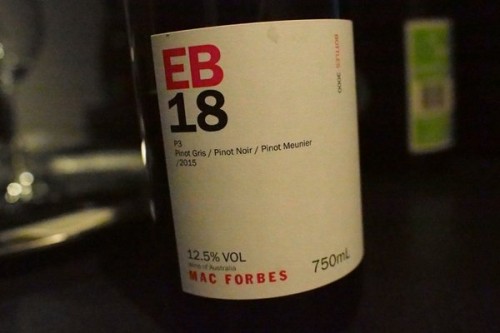
Mac Forbes EB18 ‘P3′ Pinot Gris/Pinot Noir/Pinot Meunier 2015

OLYMPUS DIGITAL CAMERA

Mac Forbes is a bit of a legend. He’s been a pioneer of lighter, lower alcohol, naturally made wines from the Yarra Valley. As well as his regular wines, he makes small quantities of ‘EB’ (experimental batch) wines. This is one of those, and just 3000 bottles were made. It’s three Pinots together: Noir, Gris and Meunier. The result is a light red wine with very interesting aromatics. I tracked this over a few days and it held up very well.

Mac Forbes EB18 P3 Pinot Gris/Pinot Noir/Pinot Meunier 2015 Yarra Valley, Australia
This is quite different. It’s a lighter red wine with a slightly subdued cherry red character. It’s pretty pale. It’s highly aromatic with sweet red cherry and strawberry aromas, seasoned with pepper and ginger, as well as some leafy herbs. The palate has a sweet red fruits character that meshes well with the herby, spicy, grippy, sappy notes. There’s a nice herby greenness here, as well as some ginger spiciness. There’s also a subtle mintiness, perhaps from a touch of eucalyptus character. This is delicious and very brave lighter-style red wine with lovely drinkability and more than a hint of seriousness. I admit, though, that it isn’t for everyone. 93/100

Find this wine with wine-searcher.com


from jamie goode’s wine blog http://www.wineanorak.com:/wineblog/australia/mac-forbes-eb18-p3-pinot-grispinot-noirpinot-meunier-2015

For Fine Wine Investment opportunities check out Twelve by Seventy Five: http://www.twelve-by-seventy-five.com/

from
http://twelvebyseventyfive.tumblr.com/post/148067647082

Monday, July 25, 2016

BK Wines One Ball Chardonnay 2015 Adelaide Hills, Australia

bkwinesoneball

This is was my drinking on Sunday night. I arrived in Adelaide late Saturday, jet-lagged as hell, and promptly crashed, sleeping through until Sunday morning. Then I woke early, breakfasted, braved the gym, showered, and went out to wander the town, after first having registered for the technical conference that I’m attending this week.

On my wanderings, I cam across East End Cellars, which is a lovely wine shop and bar just off the far end of Rundle Street. It’s got a great selection of Aussie and foreign wines, and this is one of the bottles I bought.

BK Wines One Ball Chardonnay 2015 Adelaide Hills, Australia
12.8% alcohol. This comes from a vineyard in the Kenton Valley, and the name comes from the fact that the grower is missing a testacle. Taut citrus fruit core with lovely lemon and lime notes, as well as a hint of orange peel. There’s a little peachy richness hiding under the fresh, zippy citrus, with a little toast and nut character from the oak, but this is firmly relegated to the background. Finesse and precision are the keys to this wine: it’s not giving too much away right now, but there’s a lot of promise for the future. On the back label it says ‘please decant me’, and this is one of those white wines that could really do with decanting. A taut, fine expression of Aussie Chardonnay that demonstrates the potential of the Adelaide Hills to good effect. 93/100 (A$30 East End Cellars, in the UK this is £22.50 from SWIG, and the 2013 is available from Berry Bros & Rudd for £24.95)

Find this wine with wine-searcher.com


from jamie goode’s wine blog http://www.wineanorak.com:/wineblog/australia/bk-wines-one-ball-chardonnay-2015-adelaide-hills-australia

For Fine Wine Investment opportunities check out Twelve by Seventy Five: http://www.twelve-by-seventy-five.com/

from
http://twelvebyseventyfive.tumblr.com/post/147976553367

Sunday, July 24, 2016

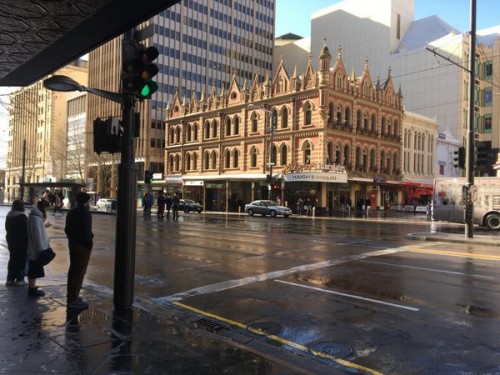
In Adelaide: discussing wine science with a taxi driver

adelaide

So, I rolled into Adelaide airport at 8 pm on Sunday night, after a long flight from London via Dubai. I altered between sleeping, working, and listening: of late, I have taken to listening to music on flights. Usually, new planes with decent in flight entertainment have a good selection, and if you bring your own headphones you can hear the music quite well. It’s a good chance to explore new stuff, and also revisit old favourites, as well as filling in gaps of things you really should know but you don’t.

On that subject, schools should teach music better. At school, we had formal music lessons as part of the curriculum until age 16, but they steadfastly ignored anything that wasn’t classical. Even jazz and blues didn’t get a look in. Our music master was pretty brutal, too. We were all scared of him, and he pulled stunts like getting us to each stand up and sing solo in front of the rest of the class. Being asked to sing ‘Early one morning just as the sun was rising,’ in a breaking teenage voice in front of your peers is worse than having teeth drilled without anaesthetic, at least in terms of the fear it induces. We need School of Rock!

I shared a cab to the hotel with Reinhard Töpfer, who is a well known grapevine breeding expert from Germany. Our cab driver, it turned out, seemed to be quite interested in wine science.

He began by telling us about a recent experience he had with a 20-year-old bottle of Penfolds Magill Estate Shiraz. He opened it, and poured it, and it was very light in colour. He was disappointed, so he poured it into a decanter and came back a couple of hours later. It had regained its colour, and he very much enjoyed it.

He wanted to know why this happened, and the explanation he’d previously received concerned the effects of oxygen. I guess the story would be that anthocyanins are able to change their form, and that some forms are colourless and some coloured. Many years in bottle might cause the anthocyanins (which will all be complexed, no longer free) to largely be in a colourless state, and then when they are exposed to oxygen, they recover to the coloured state.

More was to follow. When I told Reinhard that I’d be speaking about terroir, the driver suddenly piped in: ‘I think terroir is so important,’ he said. He explained how he thought he could tell the difference between wines grown on different soils, and that if we gave him wines from McLaren Vale, or Barossa, or Coonawarra, he could spot the difference reliably. I had no reason to disbelieve him.

‘It’s because of the taste of the soil in the wines,’ he said. When he goes to these regions, he reaches down, grabs a handful of soil, and he can then smell it in the wine.

I just love that a regular wine consumer is so interested by wine, and concepts of terroir. I’m not sure I agree so strongly with his notion that you get to taste the soil in the wine: the influence of the soil is important, but it is an indirect one. But I enjoyed listening to a taxi driver with such an interest in the science of wine. If this is reflective of the general interest level of wine among Australian consumers, then the future of Aussie wine in the domestic market is bright indeed.


from jamie goode’s wine blog http://www.wineanorak.com:/wineblog/australia/in-adelaide-discussing-wine-science-with-a-taxi-driver

For Fine Wine Investment opportunities check out Twelve by Seventy Five: http://www.twelve-by-seventy-five.com/

from
http://twelvebyseventyfive.tumblr.com/post/147929070182

In Seattle: Le Pichet and Bar Melusine

IMG_0801

There are few compelling reasons to be rich. But one of them is so that you have enough budget to eat out all the time. While I was in Seattle for the Riesling Rendezvous conference, I ate at two rather different places. I recommend them both.

IMG_0799 copy

The first was Le Pichet. It’s a small French cafe in Pike Place, and it’s a delight. Simple, well prepared French dishes and a cracking wine list. No frills. Just the sort of place that you’d like to eat at every day, and afford to, too. We stopped in for a quick lunch, and washed it down with a couple of glasses from Jean Paul Brun in the Beaujolais: the Terres Dorees Cuvée L’Ancien red 2014 (so elegant and refined) and the Terres Dorees Chardonnay 2014 (taut and mineral).

IMG_0800

The second was Bar Melusine. This relatively new, and it’s a distinctly themed, informal but stylish sort of place. The theme is the Atlantic coast of France: Normandy and Brittany. There’s a special emphasis on seafood, and the star turn here is locally sourced oysters.

A994FB58-BD7B-436C-9F13-276AC279D9DF

Four of us dined very well on lots of oysters, some fried fish skin, a salad, and roasted carrots. The wine list is quite singular, not trying to cover all the bases, but focusing on wines that serve this distinctive menu well. The result is great: lots of Muscadet, and some good representation from other parts of the Loire.

IMG_0786

IMG_0799

IMG_0840

Bar Melusine is the sort of place I’d like to eat out at often. Unlike Le Picket, though, it isn’t that affordable. You can rack up quite a big bill here fairly quickly. I blame the oysters, but the food and setting are so good, it’s worth it.

How are you going to spend your money? On things? Or experiences? I vote for the latter.


from jamie goode’s wine blog http://www.wineanorak.com:/wineblog/uncategorized/in-seattle-le-pichet-and-bar-melusine

For Fine Wine Investment opportunities check out Twelve by Seventy Five: http://www.twelve-by-seventy-five.com/

from
http://twelvebyseventyfive.tumblr.com/post/147890126127

Saturday, July 23, 2016

The Riesling Rendezvous 2016, Seattle, Washington State

IMG_0815

Three days in Seattle. So much Riesling! The fifth annual Riesling Rendezvous was in town, and I attended it for the first time.

Riesling is a grape that has had to struggle a bit to gain the recognition it deserves. ‘We are hitting our heads against the brick wall of understanding,’ said Ernie Loosen, as he kicked things off with a short introductory speech. ‘But we are making progress.’

‘Most people will love Riesling once they taste a good one,’ he says. But it is difficult to simplify the message for normal consumers. ‘I can’t omit the fact that we are talking about a wine that has a particular taste because of how it is made and where it is made,’ said Loosen. ‘There are always a lot of discussion about how to find the most simple single message, but there is no holy grail message: the simple truth is that Riesling is complicated.’

riesling rendezvous

But rather than shy away from this complexity, it should be included as part of the story, and appeal, of Riesling. ‘We should truly embrace its diversity and complexity,’ says Loosen. ‘It is not just Riesling that is complicated – wine itself is complicated. If we winemakers don’t want to simplify what we are doing, why should we make it simple for the consumers? Why shouldn’t we challenge them?’

Loosen thinks that the first step is to get people to dry good dry Riesling and then build from there. ‘We shouldn’t try to make the story of Riesling too simple. We are here to find out how we can communicate our enthusiasm and passion.’

riesling rendezvous grand tasting

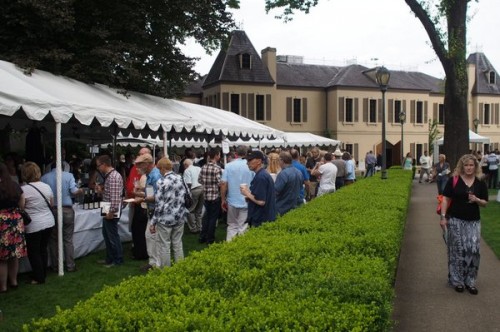
The event began on Sunday night, with a grand tasting at Chateau St Michelle in Woodinville, a thirty-minute drive out of town. This was superbly organized and enjoyed perfect summer weather, which is a good job because it was outdoors. And this is Seattle.

The wines being poured covered the world of Riesling pretty well, with a mix of famous names and newcomers. I really enjoyed it, but would have enjoyed it much more if the organizers had issued etiquette guidelines for tasting at this sort of event.

It all works beautifully if people take a pour, then exit the table to allow others to get a pour of the wine. But most consumers aren’t aware of this: they stand there, glass in hand, blocking access for others. Organizers can help a little this by not putting spittoons on tables. And then there are the producers themselves, who sometimes can be a little clueless, ignoring people waiting while they are involved in a lengthy discussion with others. This is made worse when attractive girls are involved and middle-aged guys are pouring. The German tables quickly became impossible to taste at.

Still, this was a benchmark example of a really good grand tasting, and I came across a lot of really great wines. I was driving. If I hadn’t been, I’d have probably just drunk lots and lots of Riesling. Then I’d have felt much better.

IMG_0743

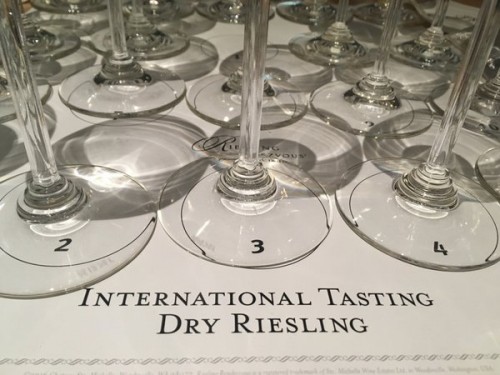
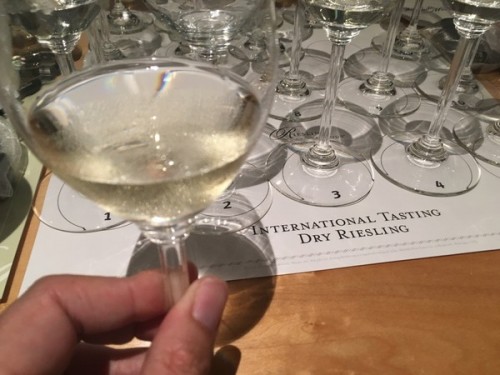
Then on Monday and Tuesday, the main sessions of the conference took place. The centrepiece of the event was a pair of morning tastings, one each day, with 20 Rieslings served blind at each. Monday’s session covered dry styles, while Tuesday’s looked at wines with a bit or a lot of residual sugar. These tastings were global, and covered wines from cheap ($8) to very expensive price points. This made it very interesting. Hands up all those who gave the $8 Chateau Ste Michelle Riesling a high score. The good news for you: you can drink cheaply for ever.

Each day had a separate panel and Ray Isle (Monday) and Joshua Greene (Tuesday) managed these panels very well. My only criticism is that the panels seemed eager to like everything, and in a few cases should have been a little more critical, and that too much attention was given on day two to guessing the identity of the wines. Seriously, dudes, you do no one any favours if when you get on a panel you just issue polite platitudes, and patronise the wines from emerging regions with excessive praise. You have been hired for your opinion. Be critical.

I learned quite a bit from these tastings. Riesling is one of the varieties where separating old world from new is actually quite difficult in many cases. It’s an incredibly adaptable grape, making compelling wines across a range of different climates. It’s also quite a good interpreter of terroirs: Rieslings grown on different soil types taste quite different, and this is something I’d love to explore in greater depth. Then there’s the curve ball of residual sugar. I don’t know any other variety where sugar levels vary so widely. The ability to manage sweetness and still be in balance is helped by Riesling’s ability to maintain good acidity levels. There’s also the interesting issue of phenolics, and their contribution to texture and flavour.

australian riesling

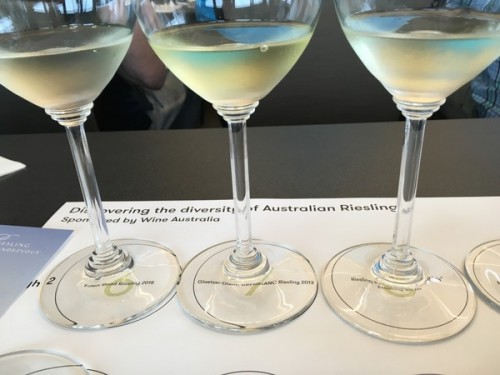
After the morning sessions, each afternoon had breakout sessions. On Monday I went to the Australian Riesling session, ably chaired by Mike Bennie. The classic Clare and Eden valley styles have always been bone dry. In part, this is a reaction to the cheap ‘Rieslings’ of the 1960s and early 1970s, when the name of the variety was used generically to describe the cheap slightly sweet whites that were popular at the time. I like the classic dry styles quite a bit, but I’m also very excited by the new wave of Aussie Rieslings that are exploring the Riesling flavour space a bit more fully.

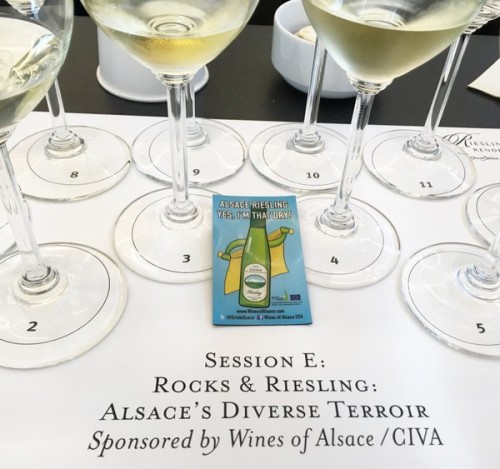
On Tuesday I attended the session looking at the terroirs of Alsace. This was led by Thierry Fritsch of the Alsace Wine Bureau, and explored some very interesting concepts. In particular, we looked at the influence of soil type on Riesling flavour. Fritsch put up a slide showing how he thinks the different Alsace soil types influence Riesling flavour. We tasted some really interesting wines, but it would have been even better if they’d each been chosen to illustrate specific terroir influences. Instead, a few of them were from a mix of terroirs, and thus weren’t as instructive as they could have been.

This was a great event. There was a real community spirit, with Riesling nuts from across the world. The continued popularity of Riesling among wine trade people still contrasts with the fact that many normal consumers don’t quite get it, and aren’t prepared to pay good money for it. But, having said this, Riesling is a grape that can make pretty good inexpensive wines.

Riesling Rendezvous does have a bit of a feel of a religious convention though. I’m a believer, but I also believe in other varieties, too. I even like Sauvignon Blanc, although I didn’t tell anyone at the conference: I would have been booted out pretty quickly. And although Riesling is one of the most adaptable grape varieties, even die hard Riesling fans will have to concede to Chardonnay, which makes stunning sparkling wine, lovely crisp unoaked wines, and full flavoured complex barrel fermented wines. It doesn’t do sweetness well, so it has to concede this ground to Riesling.

Apart from coaching consumers on etiquette at the grand tasting, there’s nothing I’d change about Riesling Rendezvous, and I’d be back in a shot.


from jamie goode’s wine blog http://www.wineanorak.com:/wineblog/riesling/the-riesling-rendezvous-2016-seattle-washington-state

For Fine Wine Investment opportunities check out Twelve by Seventy Five: http://www.twelve-by-seventy-five.com/

from
http://twelvebyseventyfive.tumblr.com/post/147882998717

Friday, July 22, 2016

The judgement of… How useful are comparative blind tastings?

OLYMPUS DIGITAL CAMERA

It’s 40 years since Steven Spurrier’s famous Judgement of Paris (also a story in Greek Mythology). This was the tasting that is credited with opening the way for New World wines to stand as peers alongside the old world classics. Since then, this sort of format has been repeated in countries eager to show that their wines belong at the same table as the famous European benchmarks.

I have just written up the second instalment of the Judgement of BC, where wines from Canada’s British Columbia region were pitted against global benchmarks. A report on the first of these can be found here.

How useful are these comparative blind tastings? I think they are incredibly useful, if they are not taken too seriously. It’s not about which wine wins; it’s about seeing where the wines fit in the global landscape. You wouldn’t expect all tasters to agree on the ranking of the wines: wine is just too complex for this. Even highly trained, expert professionals will disagree, although in the Pinot Noir part of the BC tasting we pretty much all agreed that the Meomi wine was the worst of the bunch.

As a professional, I learn a lot about wines from tasting them blind like this. I also learn a lot about my own palate. Sometimes you rate a wine you like quite a bit quite low in the rankings. For example, I like the Tantalus Old Vines Riesling, but rated it in my bottom position when I tasted it blind. I got another chance to taste it blind last week at the Riesling Rendezvous, where I liked it a bit more but I still didn’t love it. It’s a difficult wine when you encounter it blind.

It’s only by being curious, tasting lots, and banking memories of flavours, smells and textures, that we can develop our palates and get more out of the wines we drink. So any serious taster should seize the opportunity to taste blind like this.


from jamie goode’s wine blog http://www.wineanorak.com:/wineblog/canada/the-judgement-of-how-useful-are-comparative-blind-tastings

For Fine Wine Investment opportunities check out Twelve by Seventy Five: http://www.twelve-by-seventy-five.com/

from
http://twelvebyseventyfive.tumblr.com/post/147794129187

Wednesday, July 20, 2016

Underwood: Oregon wine in a can

underwood wine in a can

Underwood wines come in 375 ml cans. It’s striking packaging. I was curious, so I bought a pair to try, for $5.99 each from World Foods in Portland, Oregon. They are made by Union Wine Company. They have the admirable goal of demystifying wine and making affordable, decent wine available so everyone can enjoy it, not just wealthy dudes.

It feels a bit odd to be tasting wine from the same sort of can that you’d normally be consuming soft drinks from. Super weird, actually. The wine bottle and glass is so intrinsic to the wine-drinking experience. But these cans are just so practical. Why shouldn’t wine be served this way?

After all, for craft brewers, the can is the ultimate way to sell beer, because it allows no light or oxygen in. So if you can fill cans without too much oxygen pick-up, then it will keep the wine in top condition for ages. There is, of course, the risk of reduction issues with wines that are prone to this fault, in the absence of any oxygen transmission at all. But you can imagine having a really good time with these cans in the right situation: picnics, dining alone, at the beach, in casual restaurants.

underwood wine in a can

Packaging like this takes some of the fear out of the wine drinking experience. People are still afraid of wine: informal packaging makes it really approachable.

So how are the wines? Really good. Juicy and fruity and simple. No complications, but also quite appealing and dry, without too much make up. Perfectly judged for this packaging.

Underwood Pinot Gris NV Oregon
13% alcohol. This is simple, bright, zesty and juicy with ripe apple and grapefruit flavours. Balanced with a bit of spicy zip, and made lively with slightly elevated carbon dioxide. Drinkable and quite joyful. 86/100

Underwood Pinot Noir NV Oregon
13% alcohol. Light bodied, this Pinot has juicy flavours of sweet raspberries, cherries and rhubarb. There’s some chocolatey character, too. Fruity and lively with a simple, juicy personality and a hint of savoury meatiness. A fruity style that’s very drinkable. 87/100


from jamie goode’s wine blog http://www.wineanorak.com:/wineblog/oregon/underwood-oregon-wine-in-a-can

For Fine Wine Investment opportunities check out Twelve by Seventy Five: http://www.twelve-by-seventy-five.com/

from
http://twelvebyseventyfive.tumblr.com/post/147722882777

Tuesday, July 19, 2016

Riesling Rendezvous: why analytical data don’t tell us much about the taste of Riesling

riesling rendezvous

I’m at the Riesling Rendezvous conference in Seattle, Washington State. Held every three years, it’s an in-depth dive into this most distinctive of white wine grapes. It began on Sunday evening with a grand tasting outdoors at Chateau Ste Michelle in Woodinville, and yesterday and today we’re in Seattle for tastings and seminars.

One topic that kept coming up yesterday in the first of two grand blind tastings was the discrepancy between analytic data and the taste of the wines. Specifically, we’re talking about residual sugar (in grams/litre), total acidity (in grams/litre) and pH. Riesling is often a low pH wine with levels hovering around 3, and sometimes dipping below. The TA can vary from 6 to around 10 g/l, and residual sugar varies more with Riesling than perhaps for any other variety.

You’d think that a quick glance at the analysis would give you a clear idea of what to expect in the wine, in particular with regard to sweetness levels. But often this isn’t the case. Why?

First, there’s that interaction between acidity and sweetness. They seem to balance each other out, to a degree. A wine with low acidity and low sugar may taste just as sweet as a wine with high acidity and quite a bit of sugar. The latter will seem richer an full bodied, but not necessarily sweet. But if this were all there were to it, you could plug sugar levels and acid levels into a database and come up with a level of perceived sweetness.

There’s also the issue of fruitiness. Fruit flavours can taste quite sweet. How often have you used the term ‘sweet’ in the tasting note of an essentially dry wine?

More than this, we are not measuring devices. The brain creates flavour after some interesting processing of the signals that come from the tongue, mouth and nose, and combines this information with input from vision and even hearing, and adds in information from our prior experience and our expectations.

This computing happens below the surface, before we are consciously aware of what we are experiencing in our mouth and nose.

One example of this sort of processing is our ability to perceive ‘sweet’ smells. Wines often smell sweet, but sweet is a taste. Our noses can’t taste sweet. What has happened is that through our experience we have come to associate certain smells with sweet tastes. A great example would be fruity smells. Young wines often have fruity smells, and with time these smells diminish. Thus older wines often taste less sweet because they have fewer of the fruity aromas.

David Schildknecht, a wine critic specialising in Germany and Austria, talks of hidden sweetness in Riesling: this is in wines with quite high residual sugar, but they don’t display it. And Bob Bertheau, winemaker at Chateau Ste Michelle, says that his older Rieslings do dry out with time.

These fruity aromas make what is in our mouths taste sweeter. It’s really interesting. You can illustrate this complex perception of sweetness by a simple experiment. Prepare four sugar solutions, but make one double the strength. To one of the normal strength solutions add some fruity esters (fruity smelling chemicals). To another add some acid. If people are asked to rank them in sweetness order they will typically put the double strength solution first. Then of the three single strength solutions, the one with the fruity aromas will taste sweetest, and the one with the acid will taste the driest.

So trying to tell how sweet a Riesling will taste from the analysis alone is really difficult.


from jamie goode’s wine blog http://www.wineanorak.com:/wineblog/wine-science/riesling-rendezvous-why-analytical-data-dont-tell-us-much-about-the-taste-of-riesling

For Fine Wine Investment opportunities check out Twelve by Seventy Five: http://www.twelve-by-seventy-five.com/

from
http://twelvebyseventyfive.tumblr.com/post/147671976137

Three days in Portland, Oregon

Powell's, Portland's world famous bookshop

Powell’s, Portland’s world famous bookshop

Portland is one of the USA’s most vibrant cities. It’s known for its food and drink scene, and for being a hub for artistic, creative and alternative types. And I’ve only ever spent a few hours there. So on this trip, I decided to take some time to look around, spending three days here, with some local guidance about where to go. Here are some of the things I experienced and loved.

IMG_0652

The Woodsman Tavern, in the suburb of Richmond, is proper old school. We had a lovely seafood tower in all its retro splendour, paired with a bottle of Domaine de l’Ecu Gneiss Muscadet, which was gorgeous. The wine list here is exceptional, with a brilliantly chosen selection that’s particularly seafood friendly.

IMG_0653

expatriate pix

Expatriate (pictured above) is a really nice bar. You come here for cocktails and small bites. There’s a wine list, but it’s pretty bad. The cocktails are fab, though. And the bar snacks are brilliant. Expatriate’s bar is run by Kyle Linden Webster, and the snacks are from his wife Naomi Pomeroy, a celebrity chef whose restaurant Beast is over the road from here.

IMG_0674

One of the highlights was the informal street-like Indian food at Bollywood Theatre. This is a casual restaurant serving deliciously eclectic Indian dishes, and it’s counter service. You can eat well and inexpensively. There’s some decent craft beer on tap to wash it down, too.

IMG_0689

Suckling pig, Chesa

Suckling pig, Chesa

Chesa is a new Spanish small plates/tapas restaurant that’s run by chef Jose Chesa. The food here is superb, the ambience great, and there’s a really good wine list to boot. We had a really lovely 2005 vintage from Juve y Camps, and the beautifully bright, elegant Bastión de la Luna, a red from Rias Baixas that includes some Caino and Loueiro, among other varieties.

IMG_0670

IMG_0662

Bar Vivant

Bar Vivant

Perhaps the highlight, though, was Bar Vivant. It’s the tapas restaurant that’s a sister establishment to Pix Patisserie, and it’s a proper tapas bar. You can stand up here, eat delicious pintxo, and throw your napkins on the floor. You can also sit down, like we did, and raid the USA’s best list of grower Champagne. The tapas is delicious and authentic, and there’s also an amazing sherry list. With a Champagne list like this, it’s hard to look elsewhere. If you don’t have a Champagne budget, the the sparkling wine list is impeccable, too.

IMG_0711

IMG_0712

IMG_0721

IMG_0726

IMG_0706

IMG_0708

IMG_0718

What else to do in Portland? Well, if you are wine and beer shopping, there’s a really superb selection at World Foods, which is highly recommended. There’s also coffee: lots of it. Two of the best are Heart and Stumptown in the ACE hotel. And I was really impressed by Made Here PDX, which showcases local craft. Expensive but beautifully made local items.

IMG_0734


from jamie goode’s wine blog http://www.wineanorak.com:/wineblog/restaurants/three-days-in-portland-oregon

For Fine Wine Investment opportunities check out Twelve by Seventy Five: http://www.twelve-by-seventy-five.com/

from
http://twelvebyseventyfive.tumblr.com/post/147647930737

Monday, July 18, 2016

In Oregon: Beckham Estate Vineyard

andrew annedria beckham

Andrew and Annedria Beckham (pictured above) are making some of Oregon’s most compelling wines, and they have a great story, too.

OLYMPUS DIGITAL CAMERA

We visited their property in Parrett Mountain (in the Chehalem Mountains AVA) on a gorgeous afternoon. They have 6.5 acres of Pinot Noir, plus an acre of Riesling, which they farm organically. They are planning to move to biodynamics in the near future. Allied with this transition, winemaking has moved from conventional towards natural.OLYMPUS DIGITAL CAMERA

They are best known, though, for the use of clay amphorae. Andrew is a high-school ceramics teacher (he still teaches), and he has spent the last few years perfecting the art of producing amphorae suitable for wine.

They’ve just build a new worksop, shuttle kiln and a jigger, to make the manufacturing of these amphorae less labour intensive. Soon Andrew will be selling them, at a price that undercuts the Tuscan amphorae that some producers are now importing.

OLYMPUS DIGITAL CAMERA

By next September, 500 and 1000 litre amphorae will be on the market, and then in time a 2000 litre version. Different sizes and shapes suit different wines: conical bottoms are best for Pinot Gris, Qvevri for red wine ferments, and Tinajas for storage (they have smaller openings).

They bought their home in December 2004, and it was in the middle of woods. They cleared the area for planting with vines, and made their first wine in 2009 (just 250 cases). 2013 was a pivotal year because it was when they started with organics, started making their own wine, and also started making some wine in clay.

OLYMPUS DIGITAL CAMERA

They have just planted another 8 acres with rootstock, on more cleared ground. This rootstock will establish itself, and when they can get the new vinifera planting material they will graft it over. The varieties they are planning to plant include Trousseau, Savignan, Ploussard and Chardonnay – spot the Jura influence.

OLYMPUS DIGITAL CAMERA

The Beckam Estate wines are made using more conventional elevage, and the AD Beckham wines are made using clay. Both are fabulous.

OLYMPUS DIGITAL CAMERA

We began with the dry Rosé 2015, which is pretty and bright with lovely texture and finesse. Then we looked at the regular Pinot Noir and the Dow’s (a reserve bottling) in 2014, 2013, 2012 and 2011 versions. I really liked these: particular preferences were for the 2014 Dow’s, the 2013 Estate and the 2012 Dow’s. They are brilliant.

OLYMPUS DIGITAL CAMERA

Then: the amphora wines. There are two versions of 2014 amphora Pinot Noir: Lignum and Creta. Both are fermented in amphora, but Lignum leaves and spends the rest of its upbringing in oak, while Creta stays in amphora for its entire elevage. Both are quite brilliant. The Lignum is probably my favourite, with less impact from the amphora, but still a lovely elegance and mouthfeel that sets it apart from the regular conventional elevage Pinot, made from the same fruit. The Creta is a distinctive wine, and it’s lovely. There’s an impact from the clay in terms of the flavour, but it works really well.

OLYMPUS DIGITAL CAMERA

In 2013 just the lignum-style version was made. It’s also compelling.

We also tried the Creta from 2015 (an amphora sample!), which for me was potentially profound. It is early days for this wine, but it looks very pure and expressive.

Pinot Gris is also made in amphora here. The 2014 is a complicated, detailed, edgy wine that spent 40 days on skins in amphora, and it’s just remarkable. I’m not sure how it will develop, but it’s just so interesting.


from jamie goode’s wine blog http://www.wineanorak.com:/wineblog/oregon/in-oregon-beckham-estate-vineyard

For Fine Wine Investment opportunities check out Twelve by Seventy Five: http://www.twelve-by-seventy-five.com/

from
http://twelvebyseventyfive.tumblr.com/post/147599568617