The response of most people to the question, ‘is wine art?’ will be, ‘who cares?’ But I think it’s an interesting question, and it’s one that floated around in my mental space on a dog walk yesterday.
What is art? What is an art object? I recently had a look round a display of contemporary art at the Almenkerk winery in Elgin, which is curated by a South African academic. One of the pieces was a bit of gum stuck to the wall, while another was a section of piping with a tap in the middle, lying on the floor.
So what is it that transports these mundane objects into the realm of art? Is it the intent of the artist? That’s an unsatisfying answer. Of course, there’s potential for a digression here. Does something being classified as ‘art’ indicate that it has some merit? Is there good art and bad art? If I were to take six stones from a beach and arrange them, and call this art, is it really art? Would it make a difference if these six stones were arranged by a professional artist?
I think a much better answer is that something is art if it has meaning to an observer. If I go to a gallery and see a painting or an installation, then if it has meaning to me beyond its physical constitution or nature, it is art. Going back to the earlier example, the pipe and tap is art if it means more to me than simply being a pipe and tap.
Art is something that is experienced by our senses. So does art exist across all the sensory modalities? Traditionally, the proximal senses of touch, taste and smell have been excluded from art, as these are seen as being secondary to the distal senses of sight and hearing.
With food and drink, the act of experiencing them consumes and thus destroys them, which also counts against them as being regarded as art. But now we see that perception is a unity, and that breaking up the senses into separate modalities is illogical (most perception is multisensory, and subject to lots of hidden brain processing), then maybe we should rethink whether smells or tastes can be ‘art’.
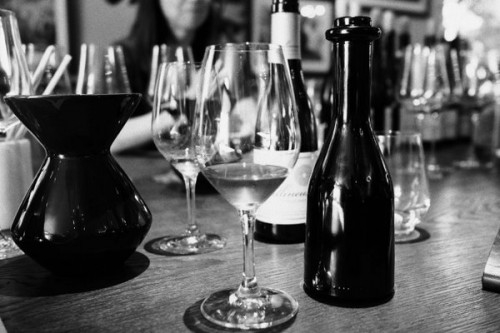
As for wine, most of it is consumed without too much thought. It is just wine. But fine wines – those wines that prompt commentary or conversation – are different. It could be argued that the experience of some wines, including the setting, the presentation, the label, the theatre of opening and pouring, and then the act of drinking, could be classified as art. Some art forms are participatory, and with the experience of fine wine, we join in. We bring a lot to the wine tasting event, and it is our participation, and the meaning that we derive from the wine, that I think allows us to consider wine as art, in some settings.
from jamie goode’s wine blog http://www.wineanorak.com:/wineblog/wine-science/is-wine-art
For Fine Wine Investment opportunities check out Twelve by Seventy Five: http://www.twelve-by-seventy-five.com/
from
https://twelvebyseventyfive.tumblr.com/post/159970159172

No comments:
Post a Comment