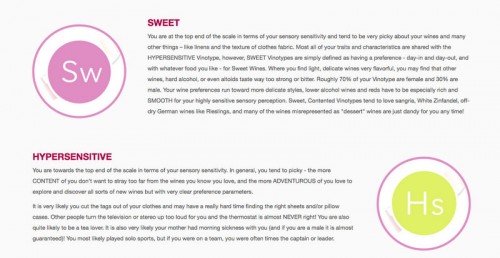
Tim Hanni MW has become well known in the wine trade for his work on separating people into different groups according to their taste preferences. He has some interesting things to say. For example, there’s this recent interview published in Meininger’s. This isn’t the first time that consumer segmentation has been applied to wine, but Hanni goes further in terms of his claims about sensory physiology and neuroscience.
I agree with some of what Hanni says. There’s some interesting work on taste preferences, and quite a bit of interesting evidence has come to light over recent years that suggests that there are some significant biological differences that lead us as individuals to prefer certain flavours over others (there’s a discussion on this in my latest book, I Taste Red).
But it’s in his application of this research to wine that I have some problems with what Hanni has to say. And I find his recommendations to wine producers based on these findings a bit alarming.
Hanni’s main point is that people have innate taste preferences and that you can separate people according to these preferences. He suggests that by selling mostly dry wines, the wine trade is ignoring the taste preferences of those who prefer sweeter styles. His thesis is that 25-40% of wines would be sweeter styles if the wine industry recognised the real taste preferences of people.
He mentions, but is somewhat dismissive, of acquired tastes (indeed be puts the word ‘acquired’ in parentheses as if to suggest that it isn’t real). But I think this is a mistake. The fact that most of our tastes are actually acquired, not innate, is the fly in the ointment of Hanni’s thesis. It changes everything, and makes much of what he says redundant.
Our preferences are extremely malleable, for good evolutionary reasons. Innate preferences for nutritious, high calorie foods are pretty universal. But we possess the ability to acquire novel tastes. Our sense of flavour combines with our memory, allowing us to explore novel, possibly nutritious food items, and these then become new flavour preferences (the memory bit is important, because we need to reject quickly things that have made us sick in the past).
Think about some of the flavours you enjoy today. I like strong cheese, but 15 years ago I wouldn’t eat cheese at all. The cheeses are still as pungent and extreme as they were 15 years ago: it’s my response to the cheese that has changed. I now love strong cheese. When I started drinking coffee as a teenager I had it with two sugars and milk. Now if you put sugar in my coffee I would find it unpalatable. I still find espresso quite bitter and a little bit aversive, but I enjoy it. When I was a kid I used to like fast food restaurants. I admit that they can sometimes make tasty food, but I’m glad that I moved on to more challenging flavours, which are much more compelling and interesting. And with wine, I began with richer, sweetly fruited reds that were easier to understand, and moved to more interesting wines over time. Now I wouldn’t find the wines I loved at first all that interesting, and I wouldn’t want to drink them. This sort of journey is not unusual.
Most of the things I love now, when it comes to flavour, were tastes that I found challenging when I first experienced them. Experience has largely trumped biology. This is what Hanni has to say:
We are all genetically pre-programmed with attractions and aversions. Changes in preferences, from about four years old to very late in life, are largely reorganising what certain sensations represent. So, with observation, culture, peer pressure, and learning we adapt to associate things we didn’t like with aspiration or attainment – something we often refer to as an ‘acquired’ taste. We also equally associate things in a negative light, ‘disposing’ of tastes as well, such as the current hysteria over sweetness in wine for those who have become more ‘sophisticated’…
…Dry wines are the new fad (in relative terms) not the historical standard; the 1947 Château Cheval Blanc had over 30 g/L (3%) residual sugar. Most prized white Rhône wines were vins de paille – dried on mats and made into sweet wines. Countless sweet wines, including Château d’Yquem, were thought completely appropriate with fish, beef, or oysters. Montrachet, in the greatest vintages, was very sweet, not dry. Champagnes, as consumed in France, often had 140 g/L (14%) residual sugar – a lot more than American Coca Cola which has 108 g/L (10.1%) residual sugar. The global sweet wine opportunity was, and still is, about 25% to 40% of the total available market. Things have just gotten out of control with the dry wine fashionistas. And keep in mind that as wine has gone dry, consumption in France and Italy has plummeted.
Where do I start? This last sentence is just silly. To suggest that the reason behind reduced wine consumption in markets such as Italy, France and Spain is connected to the fact that wines there used to be sweet but have become drier is absurd, and that’s the clear implication to what he is saying. The reduced consumption in these markets is because of social changes, and the baseline was very high to start with. In no sense has the wine got drier in these countries. If anything, it’s got a little more palatable at the bottom end, and sweeter in terms of flavour.
In terms of the ‘genetically preprogrammed’ line, it just isn’t as simple as this. We are genetically pre-programmed, if you will, to have malleable, adaptable tastes.
Hanni seriously thinks that the fact that most wines are dry these days is a push from the wine industry rather than pull from consumers, and that ‘dry wine fashionistas’ are to blame. I disagree. There’s very little market for off-dry or sweet wines not just because they are unfashionable, but because they don’t work so well with food (although there are some notable exceptions).
Another problem is created by Hanni’s refusal to segment the market. This is a common problem in these sorts of discussions. If there is a market for sweeter wine styles, it is at the bottom end. And it’s there that the sweet blush rosés of California, and the Moscatos, are doing well already. A lot of commercial reds have a bit of sweetness, too, with some grape juice concentrate added at the blending bench. Just a bit of sweetness rounds them out and covers over some of the tannin. But this is for the most commercial wines. And there’s also a market for very expensive sweet wines (some of the wine world’s great bottles are sweet), but this market is tiny and unlikely to grow.
The fact that most wines are dry, more-or-less, is because this is what the market wants. The market for mid-price to expensive wines with significant residual sugar is precisely zero. People who pay a bit more for wine want their wines dry. The market for fully sweet wines is also tiny: this is why Sauternes is having such a hard time and so many producers are struggling, while the market for high-end dry Bordeaux wines is surging.
I think it would be a huge mistake for producers to start sweetening up their wines because this is, according to Hanni, what people prefer. Once we are away from commodity wine, sweetened-up wines are usually not authentic, interesting wines. This is not the direction the wine industry should be heading. To pander to perceived biological preferences of consumers like this takes wine into the realm of manufactured alcoholic beverages. This would be a disaster, because it would mean joining the race to the bottom in terms of pricing. Profitability is a huge issue at the bottom end of the market, and in order to escape this ruthless price competition, a wine has to have authenticity and a sense of place, and not just be a wine of style.
Wine isn’t like other drinks. You get one vintage a year. You have a big winery lying unused most of the year, waiting for vintage. It’s an expensive way to make a fruity, semi-sweet alcoholic beverage of the sort that Hanni thinks we need more of. Much better to aim at producing something more sophisticated, that has some flavour characteristics that are derived from the combination of place and grape variety. This is the way out of the race to the bottom.
from jamie goode’s wine blog http://www.wineanorak.com:/wineblog/wine-science/what-determines-your-taste-why-i-disagree-with-tim-hanni
For Fine Wine Investment opportunities check out Twelve by Seventy Five: http://www.twelve-by-seventy-five.com/
from
https://twelvebyseventyfive.tumblr.com/post/166861811437

No comments:
Post a Comment